Marble refers to various carbonate rocks or magnesium silicate rocks with a hardness of 3 – 5 and their metamorphic rocks, such as marble, dolomite marble, serpentine marble, forsterite skarn, and hornfels. When their quality meets the industrial standards for decorative stone, marble deposits may be formed.
White marble is a type of marble with a relatively white color. Its color is related to its mineral composition; only rocks with calcite and dolomite as their main minerals can form white marble. Therefore, serpentine marble, forsterite skarn, and hornfels, which contain more serpentine and olivine, are mostly grayish-green or grayish-black in color and cannot form white marble.White marble is widely distributed in China, with many varieties. “White” and “jade” are common components of white marble varieties. “Chinese White Jade” is a premium white marble, characterized by its pure white color, fine texture, and strong translucency, making it suitable for high-end architectural decoration and, more importantly, for carving various high-end artworks. Due to the high recognition of “Chinese White Jade,” many white marbles on the market are labeled as such.
1. Varieties of white marble
Statistics show that there are 192 types of white marble in 27 provinces and autonomous regions of China.Color, pattern, and luster collectively constitute the decorative properties of facing stone. The naming of varieties should reflect these specific characteristics, leaving a deep impression. By analyzing the frequency of words used in these varieties, it’s evident that “white” appears almost everywhere. This is not surprising, as color is the most direct representation of a stone variety, and the name directly reflects the most prominent characteristic of white marble. Other common terms like “jade” and “snowflake” are the result of the microstructure of the minerals stimulating human vision and senses; they are macroscopic reflections of the size of the mineral grains that make up the ore. “Jade” describes the fine texture, while “snowflake” indicates the size of the constituent mineral grains, which is visible to the naked eye.

(1) In China, white marble is typically named in the following ways:
- The most common and general names highlight the color and texture, such as: white marble, snowflake white.
- Origin + Color + White: Highlights the region and emphasizes the “whiteness” of the marble.
- Place name + jade: A combination of region and texture, reflecting the quality of jade.

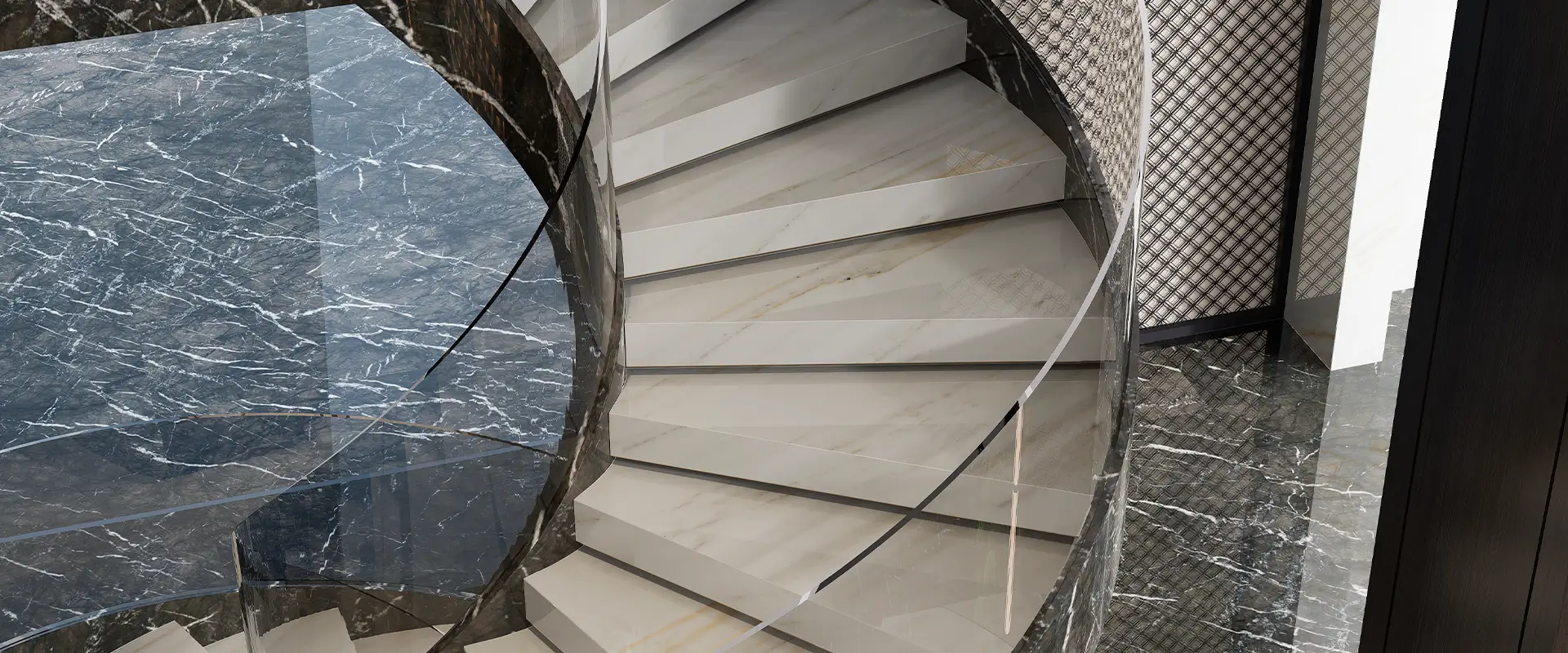
Palissandro White
2. Types of formation of white marble
White marble should specifically refer to metamorphic carbonate rocks (including marble, dolomitic marble, and transitional rocks between the two). Only through metamorphism, mineral recrystallization, and alteration leading to fading, does the color become sufficiently white to qualify as white. Light-colored limestone (of sedimentary origin, not metamorphic) is not suitable for the name “white”; it can only be described as a light-colored series, or, more accurately, “grayish-white.”
There are two main types of marble formation: regional metamorphism and contact metamorphism. Regional metamorphic marble deposits are widely distributed in shallow metamorphic zones. These deposits are large in scale, with the ore bodies occurring in layered or near-layered formations, exhibiting relatively uniform color, pattern, and texture.
Contact metamorphism forms marble deposits, which are created when carbonate rock layers are altered by the thermal or hydrothermal influence of magmatic intrusion. These deposits are characterized by marble distributed near the contact zone, the ore bodies being controlled by the contact zone, generally irregular in shape, with complex mineral composition, significant quality variations, and a smaller deposit size.Both types of white marble are primarily composed of marble and dolomite marble. The former is dominated by calcite, while the latter is dominated by dolomite.

3. Summary
The characteristics of white marble are manifested in two aspects: firstly, its macroscopic appearance of pure white color; and secondly, its microscopic appearance, examined from a mineralogical perspective, its degree of crystallization. When its crystal grains are small, dense, and fine-grained, possessing a jade-like texture, the combination of these two aspects can be named “White Jade,” or “Hanbaiyu” (汉白玉). When the mineral grains are larger and clearly distinguishable, it is called “Snowflake White” (雪雪白).
“Hanbaiyu” is considered the “most beautiful of stones,” representing a type of white marble with a fine texture and a jade-like feel. Depositional carbonate rocks, due to insufficient whiteness and lack of a jade-like feel, cannot reach the level of “Hanbaiyu”; however, through metamorphism, mineral grain recrystallization and fading alteration occur, acquiring a jade-like texture, thus potentially becoming “Hanbaiyu.”
Marble and dolomite marble used as decorative stones can be called “Hanbaiyu” as long as they are white, fine-grained, and possess a jade-like texture. The emphasis is on color and the size of mineral particles, without considering whether the mineral composition is mainly calcite or dolomite; the focus is on its decorative properties, not the name of the rock.