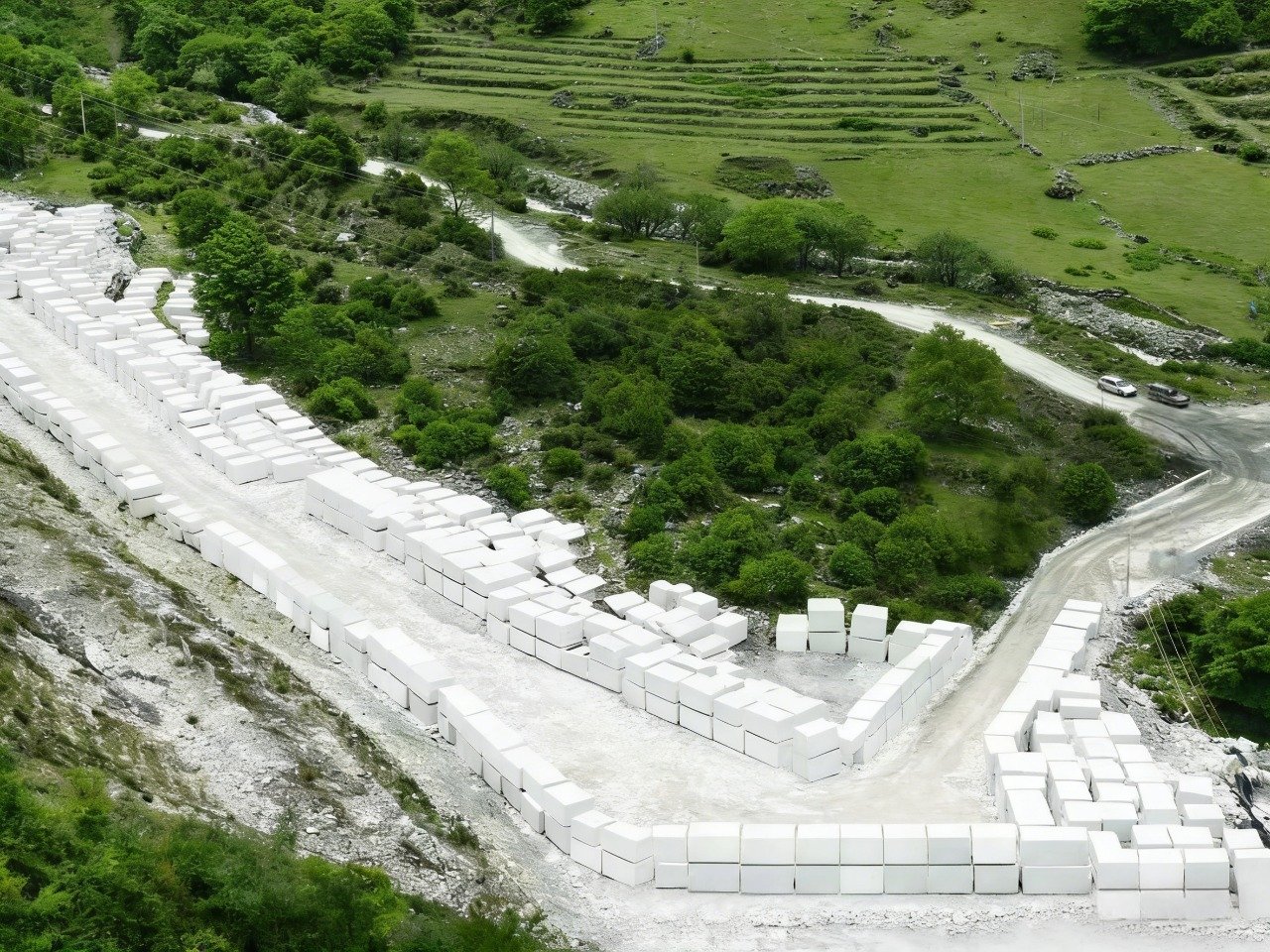
White marble has been the material of choice for sculptors and architects for millennia, from ancient Greek temples to contemporary luxury interiors. Its appeal lies not just in its brightness, but in the geological rarity of true purity. This guide breaks down what white marble actually is, how it forms, and what makes it perform the way it does.
What Is White Marble?
In geology, marble is a metamorphic rock that forms when carbonate rocks—most commonly limestone or dolomite—are subjected to heat and pressure, causing the original minerals to recrystallize into an interlocking mosaic of carbonate crystals. The term “white marble” is used both for pure calcite marble with minimal impurities and, in the stone trade, for any marble light enough in color to serve as a white or near-white material.
The key distinction: pure white marble is not simply “white limestone.” It is the result of metamorphism acting on an unusually pure protolith—a limestone or dolomite that was already poor in silicate impurities. Those impurities are what create the veins, clouds, and color variations in other marbles. When the original rock is clean, the metamorphic product is white.

Composition: What White Marble Is Made Of
The dominant mineral in most white marble is calcite (CaCO₃). Dolomite (CaMg(CO₃)₂) may also be present, depending on the parent rock. In a study of white marbles from the Iznik region, the material was fine to medium grained, composed mainly of calcite, with only localized iron-oxide staining appearing as yellowish spots.
Chemical analyses of white marbles consistently show CaO as the major oxide, typically exceeding 50 wt%. Silica content is generally very low—often below 0.3 wt% in clean white varieties—which is precisely why the stone lacks the complex silicate minerals that would otherwise introduce color. Accessory minerals, when present, may include quartz, and trace amounts of iron oxides or graphite can affect whiteness, but a high-quality white marble is defined by its carbonate purity.
For dolomitic white marbles, the mineralogy shifts: one deposit analysis showed 94.08% dolomite and 6.25% calcite in the white variety, with accessory quartz, fluorite, and corundum. The practical takeaway is that “white marble” is not a single fixed formula—it is a family of carbonate rocks unified by low chroma and high carbonate content.
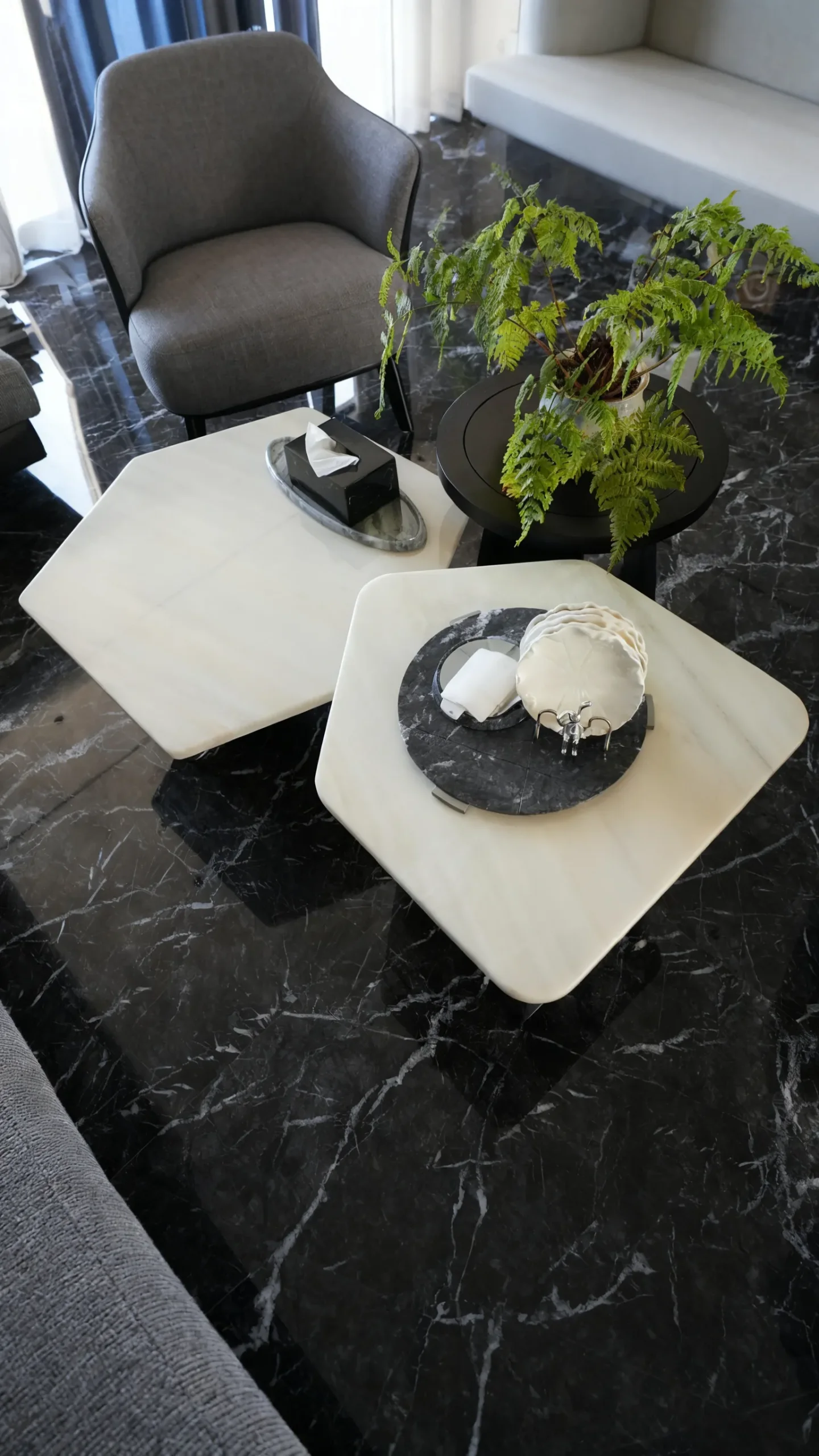
Formation: How White Marble Comes to Be
The formation pathway has two essential ingredients: a pure carbonate parent rock and metamorphic conditions strong enough to recrystallize it.Limestone or dolomite deposited in a low-silicate environment provides the starting material. During regional or contact metamorphism, elevated temperature and pressure cause the carbonate grains to recrystallize. The original sedimentary textures—fossils, bedding, muddy laminations—are largely destroyed and replaced by a granoblastic texture of interlocking crystals. If the protolith contained clay, silt, sand, iron oxides, or chert, those impurities are mobilized and recrystallized into the veins and streaks that give colored marbles their character. Pure white marble emerges only when those impurities were absent or minimal to begin with.

This is why white marble deposits are relatively scarce compared to gray, beige, or veined marbles. The geological coincidence required—a clean carbonate sequence plus sufficient metamorphism—is less common than the conditions that produce “dirty” marbles.
Properties: What White Marble Does Well (and What It Doesn’t)
Mechanical strength. White marble is a competent building stone. Reported values vary by deposit, but representative data for white marble show uniaxial compressive strengths in the range of 48–70 MPa, with density around 2730 kg/m³. A Docimian white marble sample showed 70 MPa uniaxial compressive strength and 59 MPa after frost testing, with low porosity (0.7%) and very low water absorption (0.02%).
Low porosity and absorption. High-quality white marble is dense. Water absorption values as low as 0.02–0.06% have been reported for commercial white varieties. This tight structure contributes to stain resistance and freeze-thaw durability.
Workability and polish. The crystalline mosaic structure allows marble to take a high polish, which is central to its use in sculpture and interior surfaces. It is softer than granite—calcite has a Mohs hardness of 3—so it scratches more readily, but it is also easier to carve and shape.
Thermal behavior. Marble has a low coefficient of thermal expansion, meaning it moves little with temperature changes under normal service conditions. This dimensional stability is one reason it performs well in interior cladding and flooring.
The trade-off: acid sensitivity. Because calcite is soluble in weak acids, white marble is vulnerable to etching from acidic cleaners, wine, citrus, and environmental pollutants. This is an inherent limitation of carbonate stone and should be factored into any specification decision, particularly for kitchens, laboratories, or exterior applications in acidic environments.

Choosing White Marble: What the Guide Means in Practice
For specifiers and fabricators, the “complete guide” conclusion is straightforward: white marble is a high-purity metamorphic carbonate rock. Its whiteness signals geological cleanliness; its recrystallized texture delivers strength and polishability; its calcite composition demands acid-aware maintenance
When evaluating a white marble, look beyond the surface color. Ask for water absorption, compressive strength, and petrographic description. A stone with 0.02% absorption and 70 MPa strength behaves very differently from a porous, weakly cemented material that merely looks white. The geology explains the performance—and the limitations.