Quick answer: what do Marble Slab Prices look like in 2026?
If the question is simply, “how much is a marble slab?”, the practical answer is this: common marble usually lands in the lower-to-mid range, premium marble climbs sharply, and installed pricing is almost always higher than the tag people first notice. Fabricated slab pricing is often shown at $30 to $130 per square foot, while many slab quotes average around $60 per square foot, with common slabs around $40 and rarer material going above $100. Installed pricing is often placed around $50 to $200 per square foot, with an average near $100.| Marble type | Typical material-only price | General market position |
|---|---|---|
| Makrana | $12–$25 / sq. ft. | Budget-friendly |
| Carrara | $40–$100 / sq. ft. | Popular entry to mid-range |
| Statuario | $50–$200 / sq. ft. | Premium |
| Danby | $60–$110 / sq. ft. | Mid to upper-mid |
| Arabescato | $60–$150 / sq. ft. | Upper-mid to premium |
| Calacatta | $175–$400 / sq. ft. | High-end luxury |
| Portoro | $200–$300 / sq. ft. | High-end luxury |
| Example slab size | Ballpark slab cost |
|---|---|
| 8 x 4 ft | $1,920 |
| 8 x 6 ft | $2,880 |
| 10 x 4 ft | $2,400 |
| 10 x 6 ft | $3,600 |
Why Marble Slab Prices change so much
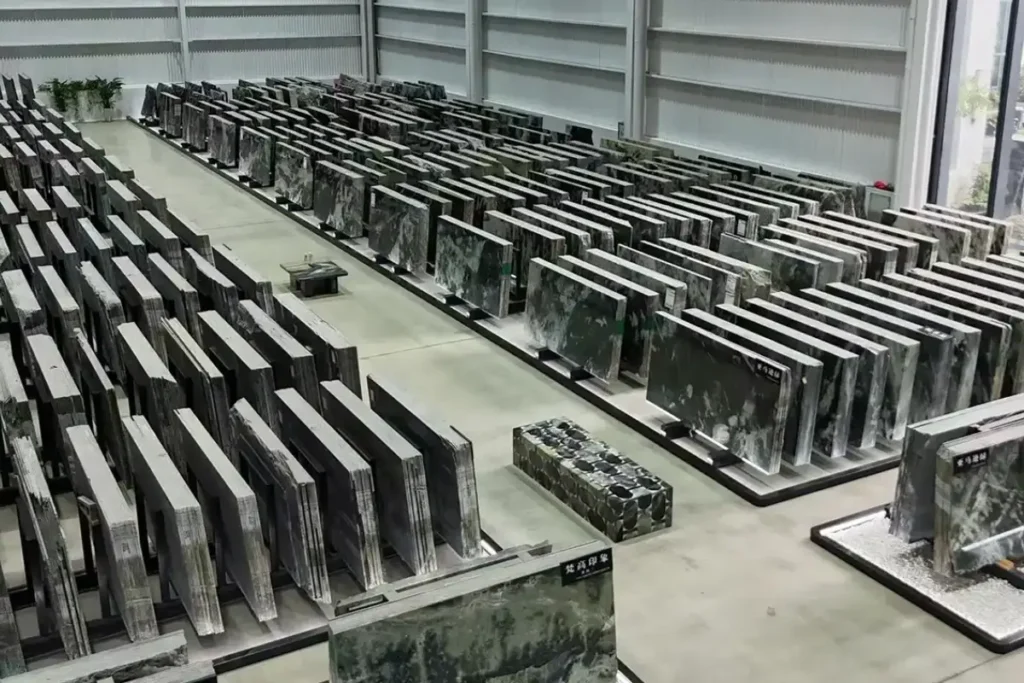
A lot of buyers assume marble pricing is mostly about color. It is not. Color matters, yes, but the bigger drivers are usually the stone’s origin, how rare the pattern is, the slab grade, thickness, finish, and then the practical stuff nobody loves talking about—transport, cutouts, edging, layout difficulty. Type, quality, thickness, finish, and location are all major price drivers, and that lines up with how quotes tend to behave in the market.
1) Type and origin
This is usually the biggest swing factor. Carrara stays popular because it gives that classic white-and-gray marble look without automatically landing in the highest bracket. Calacatta, Statuario, and Portoro, on the other hand, are premium names for a reason. In 2026 pricing references, Calacatta is often placed at $175 to $400 per square foot for materials only, while Portoro sits at $200 to $300, well above Carrara’s $40 to $100 material range. Iconic Calacatta Borghini is also more expensive because it is quarried in one location in Carrara, Italy, with limited supply.
2) Slab grade
Grade sounds technical, but it is really about how “clean” a slab looks and how many visible defects or repairs it has. Marble is often divided into grades A through D. Grade A is the premium tier with minimal visible imperfections and more regular veining, while lower grades can show pits, cracks, repairs, or more irregular movement. Sometimes a lower-grade slab still looks great in a rustic or dramatic room, so the highest grade is not always the only smart buy. Still, grade changes Marble Slab Prices in a hurry.
3) Thickness and finish
Marble slabs are commonly sold in 2 cm and 3 cm options, and that alone can shift the quote because thickness affects material volume and fabrication. Finish matters too. Polished finishes can add cost, and thickness and finish are both part of the pricing equation. So yes, two slabs with almost the same look can land at noticeably different numbers once thickness and surface finish are selected.
4) Fabrication complexity
This is where a “cheap” slab sometimes stops being cheap. Tight corners, multiple sink or faucet cutouts, seam matching, difficult access, stairs, old countertop removal, and fancy edge profiles all add work. Stairs, cutouts, seam matching, intricate layouts, demolition, edge upgrades, backsplashes, and sealing are all common extra cost drivers. A flat rectangle is one thing. A large island with waterfall sides is another story entirely.
Average Marble Slab Prices by marble type
This is where the market starts to feel a little more real. Not every buyer is shopping for “marble” in the abstract. They are shopping for Carrara, maybe Danby, maybe Arabescato, maybe a Calacatta slab that looked perfect under the warehouse lights.| Pricing view | Typical 2026 range | What it usually means |
|---|---|---|
| Fabricated marble slab | $30–$130 / sq. ft. | Stone that has been cut and finished, but not always fully installed |
| Common slab quote | Around $40–$60 / sq. ft. | Often entry-level to mid-range marble |
| Premium slab quote | $100+ / sq. ft. | Rarer or higher-grade marble with stronger visual character |
| Installed marble countertop | $40–$150 to $50–$200 / sq. ft. | Material, fabrication, and labor combined |
Marble Slab Prices by project size, not just by square foot
Per-square-foot pricing is useful, but buyers usually make decisions based on total job cost. And that total can feel very different once the room size becomes real.| Countertop size | Typical installed cost |
|---|---|
| 10 sq. ft. | $500–$2,000 |
| 20 sq. ft. | $1,000–$4,000 |
| 30 sq. ft. | $1,500–$6,000 |
| 35 sq. ft. | $1,750–$7,000 |
| 40 sq. ft. | $2,000–$8,000 |
Hidden costs that quietly reshape the quote
This is the part shoppers often skip, and then regret skipping. Material cost is only one layer of the number.
- Labor: Labor is often estimated at about $10 to $30 per square foot, or roughly $35 to $45 per hour depending on the contractor and market.
- Sealing: Initial sealing can add about $100 to $350, and some guides suggest budgeting for periodic resealing as part of ownership.
- Edge profiles: Beveled and bullnose edges can add roughly $10 to $15 per linear foot, while decorative profiles like Ogee or Dupont can reach about $25 per linear foot.
- Old countertop removal: Demolition and haul-away can add around $50 to $300.
- Backsplashes: Many backsplash projects are estimated around $500 to $1,500, with matching marble backsplashes potentially much higher.
- Transportation and access: Distance from the fabricator and site difficulty can increase pricing, and stairs and tight handling conditions add labor pressure too.
Put simply, a showroom tag is rarely the final number. A more accurate budget comes from material plus fabrication plus installation plus the odd little complications that every real house seems to have.
How to buy smarter when comparing Marble Slab Prices
The cheapest quote is not always the best quote. It is often just the least complete one. A more useful approach looks something like this:
- Ask whether the number is material only, fabricated, or fully installed. This single question clears up a lot of confusion because online guides mix these categories constantly.
- Ask for the exact marble name and grade. “White marble” is too vague. Carrara, Danby, Arabescato, and Calacatta do not live in the same price bracket.
- Confirm thickness and finish early. Marble offerings commonly include 2 cm and 3 cm formats, and finish choices can alter price and upkeep.
- Request a line-item quote. Labor, sealing, edge profile, demolition, backsplash work, and cutouts should not be hidden inside a mystery total.
- Check whether remnants are available for small areas. Bathroom vanities, laundry rooms, coffee bars, and side counters can sometimes use overstock pieces at a better value.
This is usually where budget planning becomes less stressful. Not glamorous, maybe. But more useful.
Maintenance matters because ownership cost is part of Marble Slab Prices too
Marble can be worth the money, but only if the buyer understands what the material is asking for. Marble is a metamorphic stone composed mainly of calcium carbonate, which is sensitive to acidic solutions. That means vinegar, citrus-based cleaners, and other acids are not friendly to marble surfaces.
Routine care is actually pretty simple. A pH-neutral cleaner, stone soap, or mild dishwashing liquid with warm water is usually recommended, followed by a rinse and soft drying cloth. For spills, the general advice is to blot immediately rather than wipe, because wiping spreads the liquid. There is also one important point about sealing: sealing does not make marble stain-proof, it makes it more stain-resistant and gives a little more time to clean up spills before they sink in.
That last part is easy to underestimate. A lot of owners assume sealing is a permanent shield. It is not. It is more like a buffer. Helpful, yes. Magical, no. Many guides also suggest budgeting for resealing roughly once a year, though the exact timing depends on the stone, the sealer, and the supplier’s recommendations.
Conclusion
A sensible short answer is this: most Marble Slab Prices start around the lower double digits per square foot for budget material, move into the $40 to $100 range for popular stones like Carrara, and can rise into the $175 to $400 range for high-end names like Calacatta before installation is even included. Once fabrication and labor enter the picture, many finished jobs land somewhere between roughly $40 and $150 or $50 and $200 per square foot, depending on the guide and the job complexity.
In other words, marble can be relatively approachable, or genuinely luxury-priced. Sometimes both things are true on the same day, just in different warehouses. The smartest way to read Marble Slab Prices is to stop looking for one perfect number and start looking for the right range, the right marble family, and the right scope of quote. That is usually where the budget starts to make sense.
FAQ
Is a remnant better than buying a full slab for a small bathroom vanity?
Often, yes. Some pricing references specifically suggest cut-offs or overstock for smaller projects because they can reduce material cost without changing the visual impact very much. For vanities, bar tops, or short counter runs, a remnant can be one of the most practical ways to get real marble without paying for a full premium slab.
Does marble make sense for a pastry station even if it feels risky for a full prep kitchen?
It can. Marble has a naturally cool surface, which is part of why it remains appealing for cooking and baking zones. The trade-off is care: because marble is calcium-carbonate based and sensitive to acids, frequent contact with lemon, vinegar, or acidic cleaners can dull the finish over time. That is why some buyers feel comfortable using marble in baking or low-acid work areas, while being more cautious about heavy everyday prep zones.
Can a honed finish make daily wear less obvious than a polished finish?
Yes, in many homes it can. Honed marble’s matte surface tends to hide scratches and etches better than polished marble, especially in high-traffic areas. Polished marble still looks richer and more reflective, but it usually shows dull spots more readily when the surface is etched.