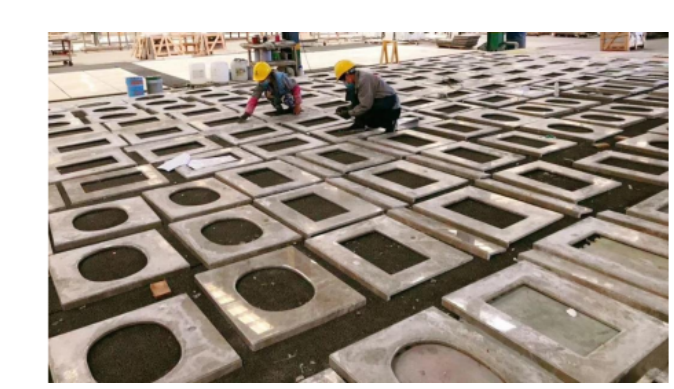
The application of stone countertops is increasingly widespread. They are not only extensively used in hotels, guesthouses, and office buildings but are also now widely applied in home decoration, particularly for TV stands, coffee tables, various furniture countertops, and kitchen cabinets, making them highly popular in residential decor. Although stone countertop products are not particularly complex in terms of processing technology, many detailed aspects must be carefully observed during their production.
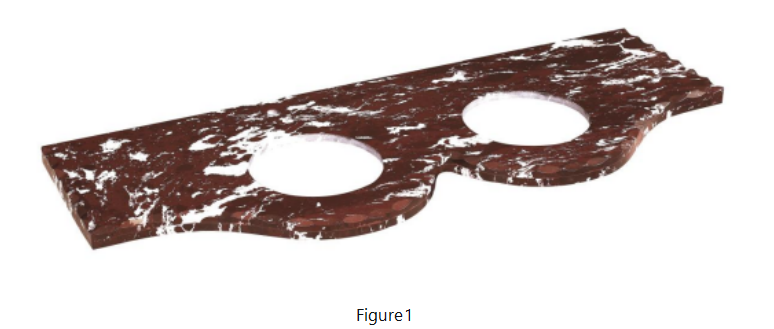
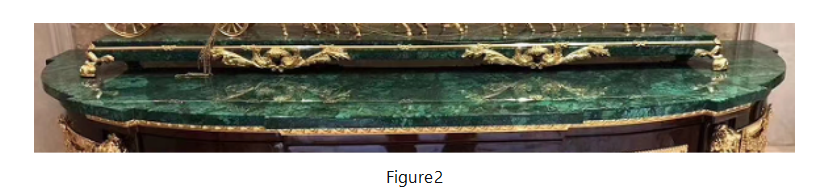
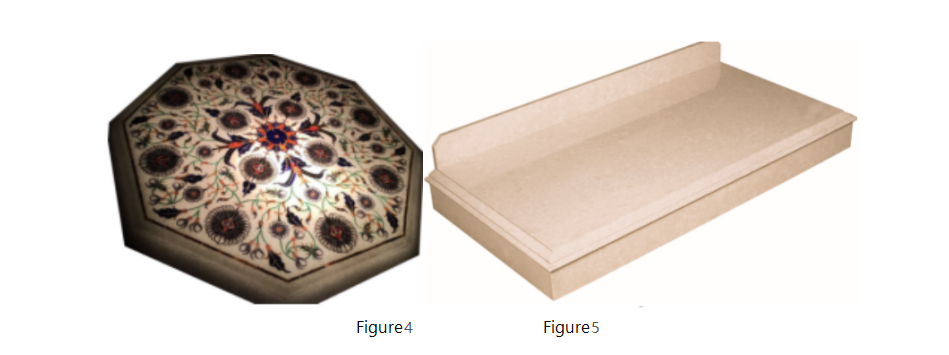
Taking the thickened countertops shown in Figures 1 to 5 as examples, the following eight details must be emphasized during processing: the color and texture of the thickened edge should be basically consistent with those of the countertop; the color and texture of the backsplash should match those of the countertop; the size of the adhesive joint between the thickened strip and the countertop; the color of the adhesive joint between the thickened strip and the countertop; the quality of the countertop’s surface repair (filling); the quality of the countertop’s edge polishing; the color and texture consistency for countertops requiring joint assembly; and the strict inspection and quality control of stone countertop products. These eight details are critical in countertop processing. Neglecting them can result in poor-quality countertops, severely compromising the decorative effect. Therefore, attention to these processing details is essential and must not be overlooked.
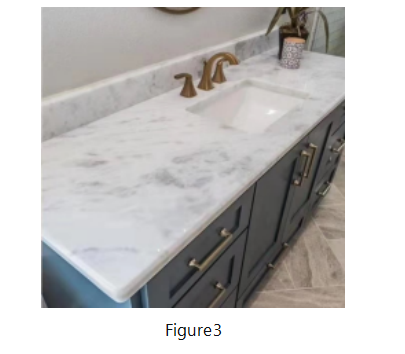
In Figure 5, the countertop not only features a thickened edge but also includes both an upper and a lower backsplash. Therefore, during processing, in addition to ensuring that the color and texture of the stone used for the thickened edge are basically consistent with those of the countertop, it is also necessary to ensure that the color and texture of the upper and lower backsplashes are basically consistent with each other and with the countertop.
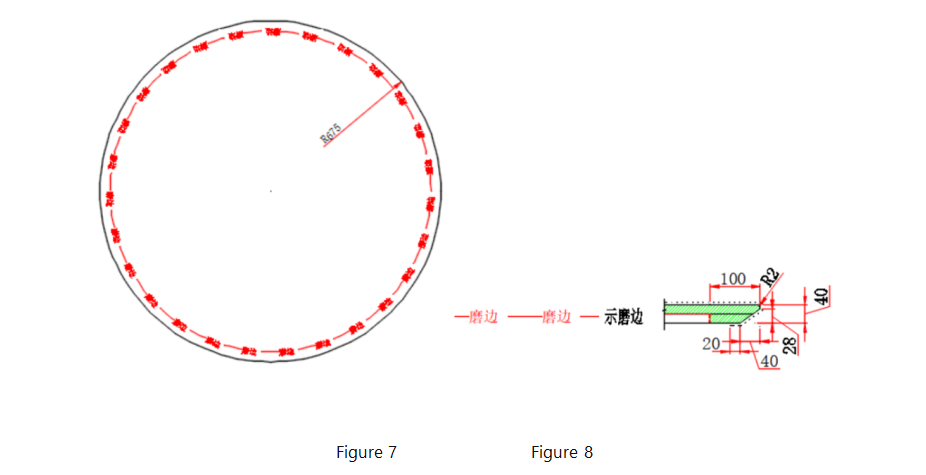
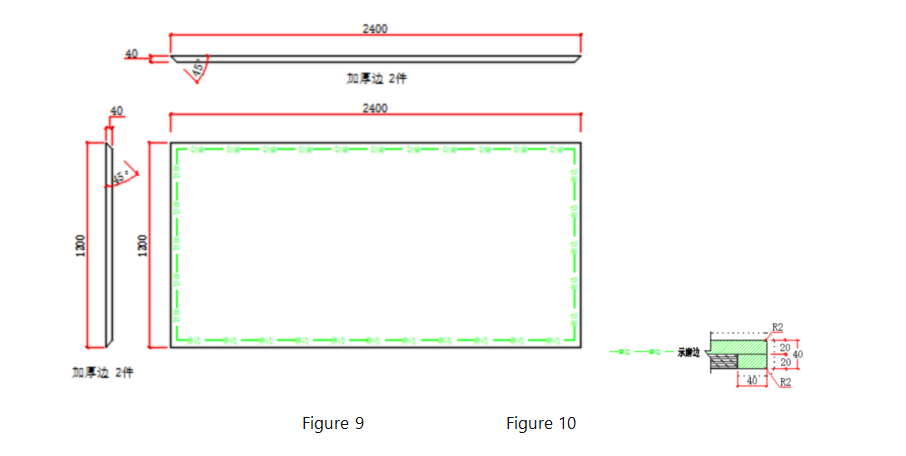
Figures 7 to 10 are CAD drawings of the thickened countertop, which show how production staff know how to process the thickened countertop.
(1) The thickened edge maintains a consistent color and texture with the countertop.
This requirement is mainly controlled during board cutting and bonding. When cutting the tabletop and thickening strips, the bridge cutter should ensure that the thickening strips and tabletop are ideally selected from the same large sheet and cut at the same location. If cutting from a different large sheet is necessary due to insufficient material, the color and texture must be matched, and the cutting should be done at a point where the color and texture are essentially the same. After the adhesive strips and tabletop are cut, they should be numbered and placed in matching sets. Before bonding the thickening strips, the bonding worker should check the color and texture of the adhesive strip and tabletop, and only bond them after confirming that the color and texture of the adhesive strip match.
(2) The backsplash and countertop should match in color and texture.
When cutting the countertop with a water baffle as shown in Figure 5, follow the requirements of (1), and place it according to the set number. When arranging the boards, the arranging staff should carefully arrange the boards according to the set, check, adjust the color, number them, and mark the direction of the grinding edge.
(3) Size of the adhesive gap between the thickened strip and the countertop
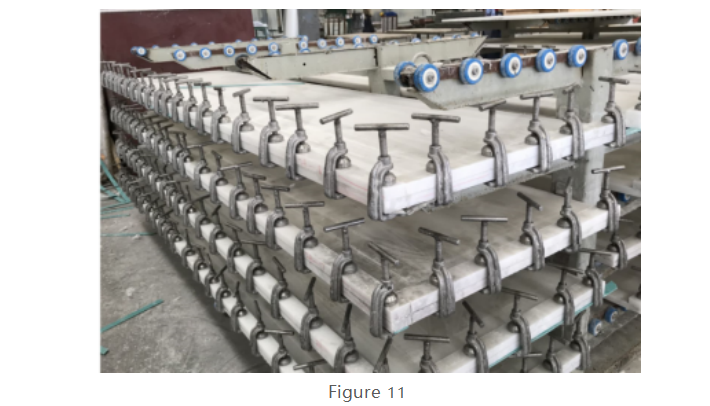
Figure 11 shows the bonding diagram of the thickened countertop. Before bonding, the colors of the thickened strip and the countertop must be checked to ensure they are basically consistent. Otherwise, if the colors and textures of the thickened strip and the countertop differ too much, it will greatly affect the decorative effect. Figure 11 shows the use of numerous clamps during the countertop bonding process. The purpose is to clamp the thickened strip and the countertop tightly, increasing the adhesive force between them, reducing the gaps between the thickened strip and the countertop, and ensuring a small bonding gap and good bonding effect. When the bottom edge of the countertop is severely chipped, the chipped areas are eliminated through mechanical thickness setting or manual grinding to minimize the bonding gap.
(4) The color of the seam between the thickened strip and the countertop.
The adhesive mixing should be carried out by a professional adhesive technician, who will prepare the adhesive to match the dominant color tone of the stone countertop. During mixing, strictly follow the adhesive’s specified mixing ratio. After preparing the adhesive, perform a trial bonding on one piece first. Allow it to cure for one hour, then scrape off the excess adhesive from the surface to be bonded and check whether the color of the adhesive meets the requirements. If the color is satisfactory, proceed with large-scale bonding.
Do not prepare excessive amounts of adhesive at one time; it is best to prepare only the required quantity. Do not use any mixed adhesive that has been left overnight.
Prior to bonding, thoroughly clean the surfaces to be bonded to ensure they are free of dust, dirt, or any other substances that may affect the adhesive’s color. If the color of the adhesive at the bonding joint is incorrect, use a single-edged razor blade to remove the adhesive and re-mix a new batch to repair the joint.
The quality of crack repair (or adhesive filling) on the countertop
As stone products that come into close contact with people’s visual perception, and given that marble often has many surface cracks, the quality of crack repair (filling) on marble countertops determines the overall quality, price, grade, and class of the product. In addition to careful and meticulous repair during slab processing, the repair work must also be handled seriously during the countertop fabrication process. Any poorly repaired areas should be removed and re-repaired. The repair quality of marble countertops must meet the following requirements: the gloss at the repaired area should be essentially the same as that of the surrounding surface; no visible repair marks should be noticeable when viewed directly from the front; under raking light, the repair痕迹 should be barely visible; the color of the repaired area should be basically consistent with the dominant color tone of the stone; when touched by hand, the repaired area should show no obvious difference in feel; the repair adhesive should not discolor over time; and there should be no shrinkage or depressions at the repaired area.
(5) he edge polishing quality of the countertop
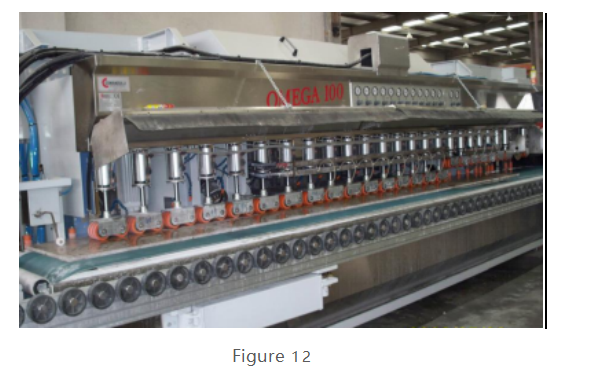
It is best to achieve mechanized edge polishing for the countertop. If mechanized edge polishing is not feasible, the edge should be shaped using a profiling wheel, followed by manual finishing carried out by skilled workers with a high level of expertise in grinding and polishing.
(6) Color and Texture Requirements for Countertops with Jointing Relationships
For countertops that have jointing relationships, material planning must be carried out before cutting the slabs. The bridge cutting operator shall strictly follow the material plan when cutting the countertops, cutting and numbering them in sets. The layout personnel shall arrange the countertops by set to inspect the color and texture, promptly identifying any issues and replacing any parts that differ in color or texture. Once the layout is completed and the inspection is passed, each set shall be numbered accordingly, placed in order by set, and then transferred to the next processing stage.
Strengthening Strict Inspection and Quality Control of Countertops
Finished countertops shall be laid out, inspected, and tested by set. Special attention should be paid to checking the quality of surface crack repair (filling), as well as the presence of any grinding marks or scratches on the surface. Particular emphasis should also be placed on verifying whether the color and texture of the thickened strips match those of the countertop; the quality and appearance of the adhesive joint and color between the thickened strip and the countertop; the straightness of the polished edges; and for countertops with backsplashes, they shall be numbered by set and packaged accordingly.