Black marble is not a single stone but a family of deeply hued, crystalline carbonate rocks whose origins trace back hundreds of millions of years to ancient seabeds.
What Exactly Is Black Marble?
Geologically speaking, what the trade calls “black marble” is almost always a recrystallized carbonate rock—the product of limestone or dolostone that has been subjected to intense heat and pressure, forcing its calcite crystals to fuse into a dense, interlocking mosaic. The black color itself is rarely a mineral pigment. Instead, it comes from carbonaceous material or bitumen trapped within the stone during formation, ancient organic matter that never fully escaped the rock cycle.
This distinction matters because many “black marbles” on the market are technically polished black limestones, not true metamorphic marbles. Belgian Black, for instance, is often classified as a fine-grained calcareous sedimentary formation rather than a fully metamorphosed marble. To the naked eye, the difference is almost impossible to detect. Both types can achieve a deep, mirror-like black when polished.
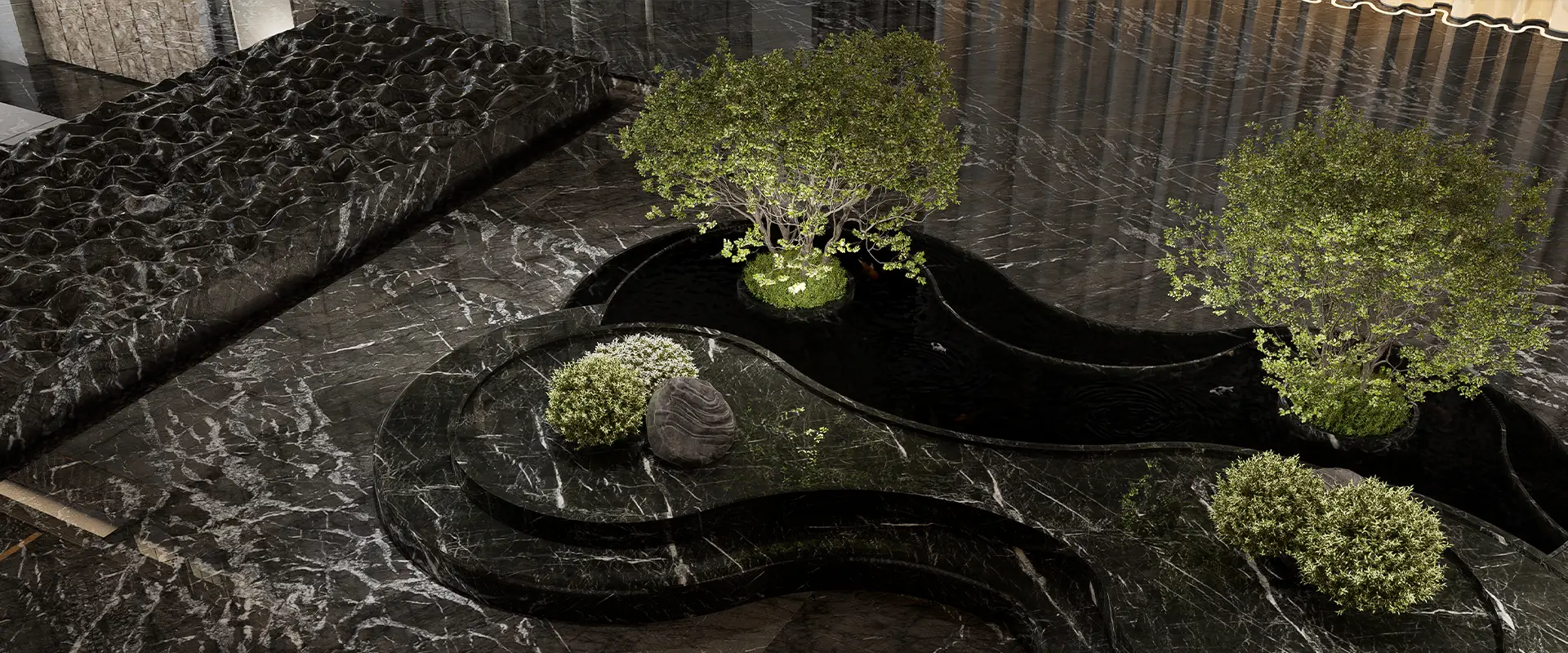
Origins: Where Does Black Marble Come From?
Black marble deposits are scattered across the globe, but a few regions have historically dominated production. Each owes its character to a distinct geological history.
Belgium holds the most storied claim. Noir Belge (Belgian Black) originates from fine-grained calcareous deposits dated to the Frasnian era of the Upper Devonian, roughly 360 million years ago, along the northern border of the Namur sedimentary basin. Roman quarrying began in antiquity, and the stone’s unmatched velvety black made it a favorite of Renaissance artisans, including the Medici workshops in Florence and, reportedly, the intarsia decoration of the Taj Mahal.
Spain’s Basque Country produces Nero Marquina, the benchmark black marble with a jet-black base and dramatic white calcite veining. Its calcite content reaches 98%, giving it both purity and structural consistency.
Italy offers Portoro, a high-end black crystalline marble from Liguria whose intense jet base carries dynamic golden veins and white effervescences. It is frequently cited as the most expensive black marble in the world. Carrara, better known for its whites, also yields a black variety called Nero with yellow quartz veining.
Brazil has emerged as a major source of exotic black “luxury stones” in recent decades. Versace Black, despite its fashion-house name, is a natural black marble from a specific Brazilian mining region, prized for silver-gold flowing crystal veins that shimmer under directional light.
China possesses numerous black marble varieties as well, including Guilin Black (Guangxi), Shaoyang Black (Hunan), and Black & White Root (Hubei), the latter distinguished by its striking white veining against a black ground.
Why Is Black Marble Rare?
Rarity in black marble operates on two levels: geological scarcity and extraction difficulty.
True uniform black marble forms only under specific conditions—limestone must be buried deeply enough to recrystallize, yet the carbonaceous material must remain evenly distributed throughout. The slightest variation produces gray zones, color streaks, or fractures. Extracting large, flawless slabs without visible breaks is particularly challenging, and this directly influences cost.
Belgian Black illustrates the second constraint vividly. Its quarries at Golzinne and Bioul operate underground, with limited production capacity. Good Belgian Black is dug as an inconspicuous gray stone; only after polishing does it reveal its immaculate deep black. From World War I onward, the combination of difficult underground exploration and progressive exhaustion of accessible reserves pushed the material toward the most exclusive architectural and artistic uses.
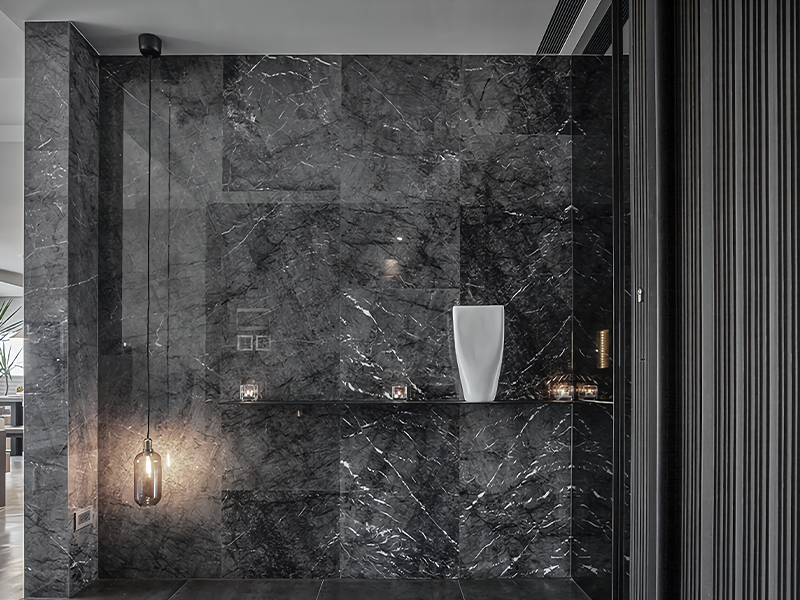
The Most Coveted Varieties Worldwide
Nero Marquina (Spain)
Deep black base with bold white veining. The benchmark for dramatic contrast in interiors. It hides staining exceptionally well, making it practical as well as beautiful.

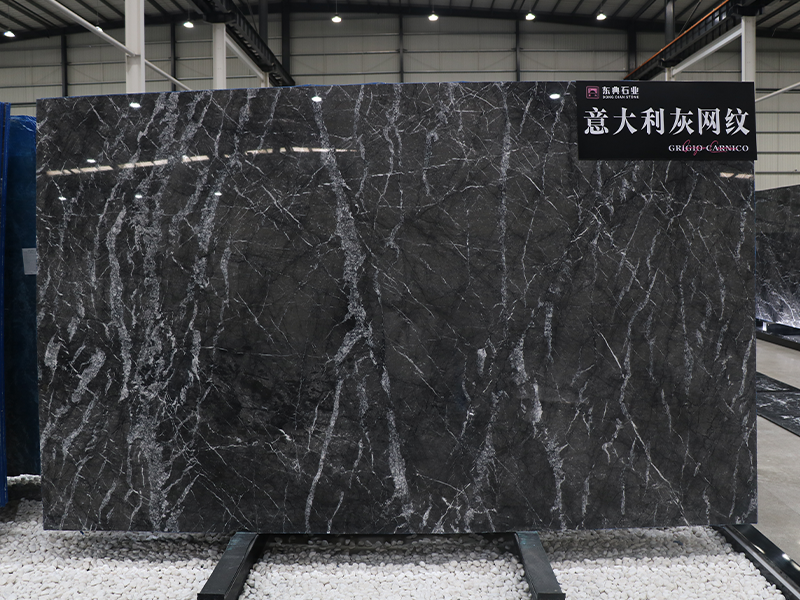
Grigio Carnico (Italy)
Jet black with white veins and white efflorescences that appear to move. Widely regarded as the most expensive black marble globally.
Noir Belge / Belgian Black (Belgium)
Immaculate velvety black with a remarkable high gloss. Historically used by European artisans for intarsia and pietra dura. Now one of the most expensive marbles in the world due to scarcity.

Versace Black (Brazil)
Pure ink-black base with natural silver-gold flowing crystal veins. Classified as a “luxury stone” for its unique texture and limited global supply. Mohs hardness around 6.5, unusually high for marble.
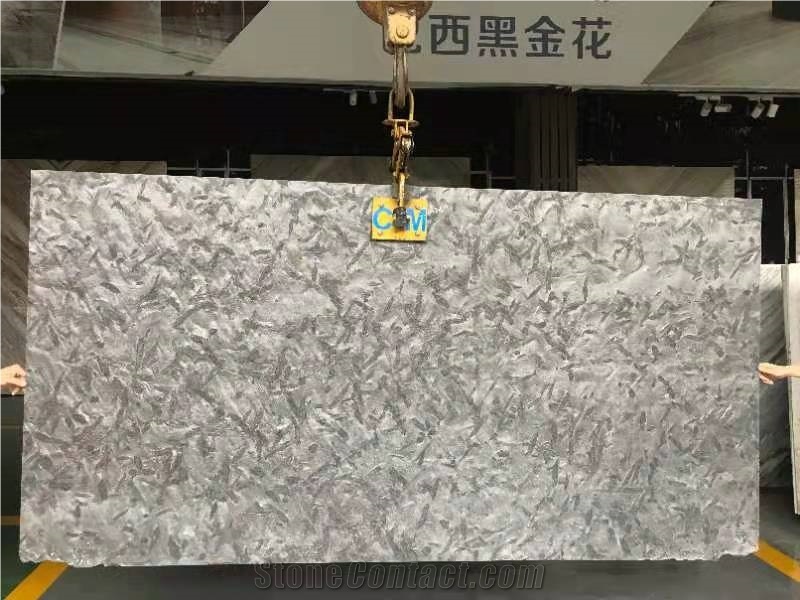
Saint Laurent (France)
Coppery black marble with delicate brown, gold, and white veins touched by occasional coral notes. Considered a semi-precious stone and used for design elements and interior cladding.

Thassos Black (Greece)
From the same geological region as the famous Thassos White. A deep black with minimal veining, prized for applications demanding a pure black surface.

A Note on Terminology
“Marble” in the stone trade is more inclusive than in geology. Many stones sold as black marble are technically polished limestones—sedimentary rocks that have not undergone full metamorphism but still take a high polish and display the dense, uniform appearance buyers expect. Belgian Black is the most prominent example. For practical purposes—durability, stain resistance, visual effect—the distinction often matters less than the specific quarry and grade.
Summary
Black marble originates from ancient seabeds transformed by heat, pressure, and time. Its blackness comes from carbon trapped within the stone, not from pigment. Its rarity stems from both restrictive geology and difficult extraction. The most coveted varieties—Nero Marquina, Portoro, Belgian Black, Versace Black—each carry a distinct signature: white lightning veins, golden flows, velvety uniformity, or shimmering crystal textures.